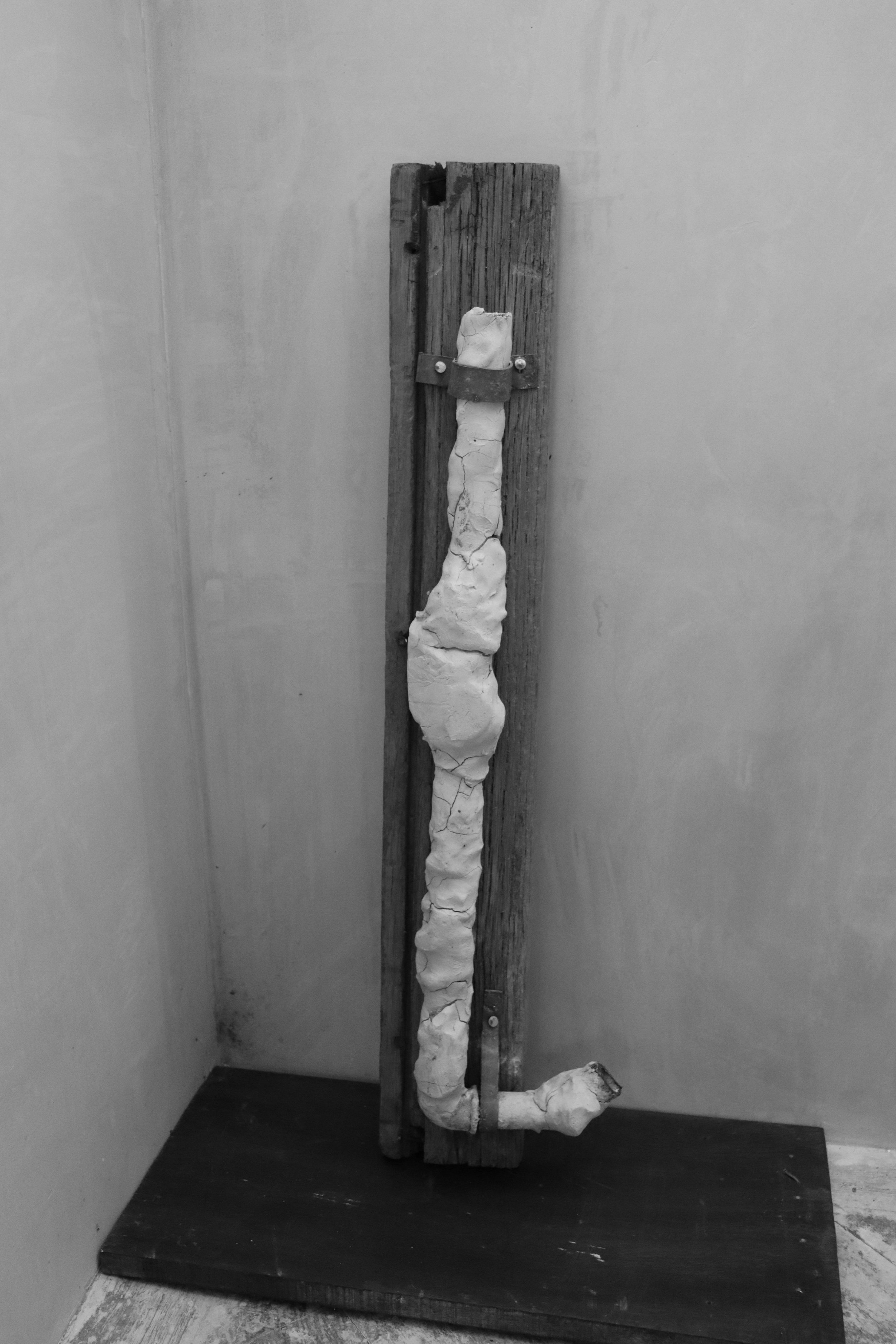
The Serpent ate a Rat
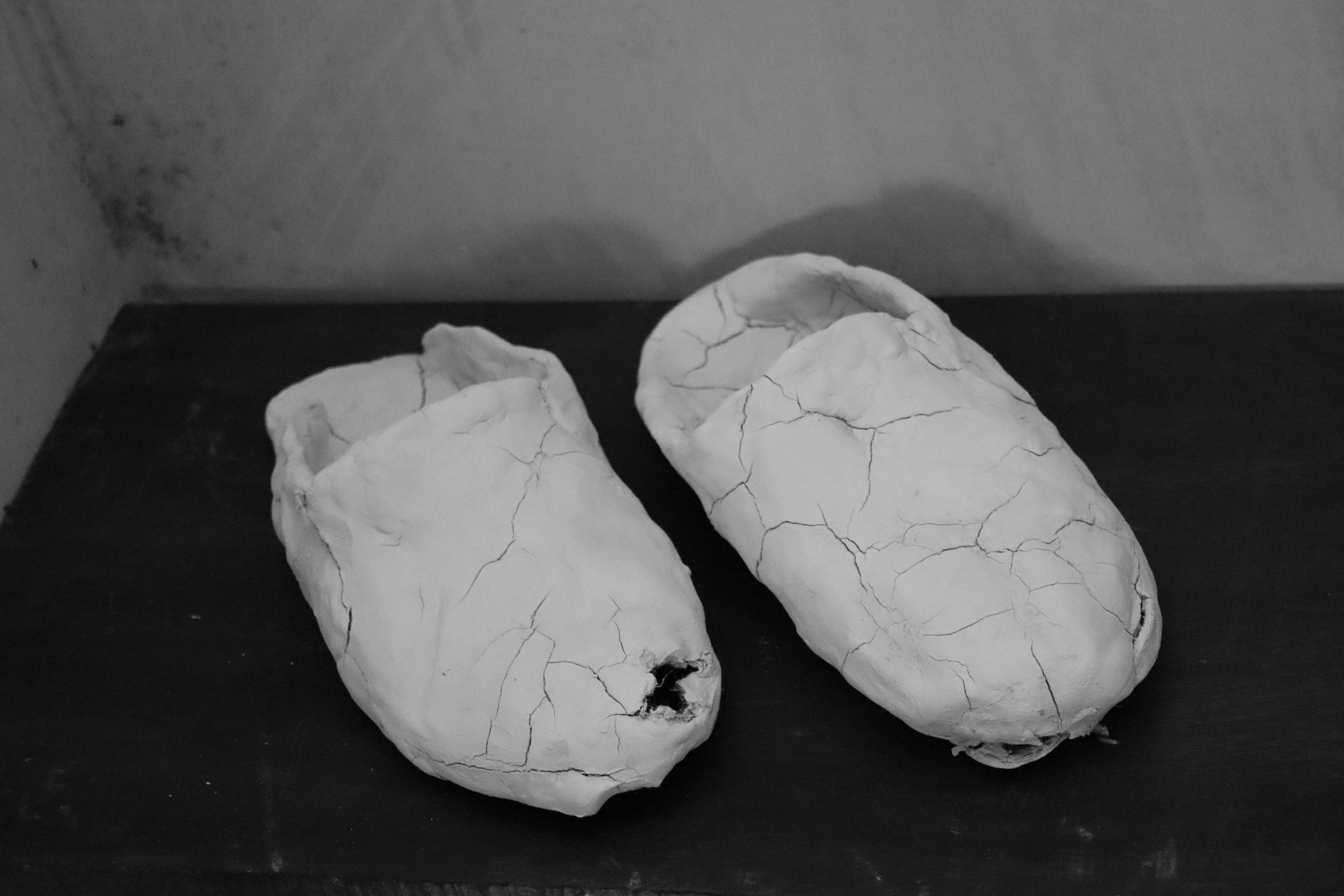
Slippers
Influences and Process – After the Fire
It started with a fire. I was unhappy about the direction my work was taking so I bought a garden incinerator and set it ablaze, all except a few small pieces. The theme of these few watercolours centred around a fire and a thief in the Garden of Eden.
Initially I was surprised at how little ash remained after so much material was incinerated. I carefully picked through the remains and still managed to find one or two tiny fragments of old work. If both time and thought could be reduced to dust, I’m sure there would have been a much larger pile of Ash.
At this time, I was already interested in the subject of Alchemy, its history, the material processes involved and its cultural significance. I also became interested in Carl Jungs writings on the subject and James Hillmans theories in Alchemical Psychology.
I started working with dark colours, in particular Black Bitumen and Caput Mortuum. Bitumen was extensively used in the 18th and early 19th century to give a richness to dark areas of the paintings without the use of black. Unfortunately, its unstable nature led to the colour leaching in many areas of the work, resulting in discolouration and cracking (The Raft of the Medusa 1819, Theodore Gericault). It was this very instability and its many other qualities that made me want to work with it.
Caput Mortuum, is a term relating both to a process in Alchemy and a substance. The substance is the name given to the debris, the unwanted, useless remains resulting from the process of Putrefaction and Calcination. It is essentially associated with the Nigredo stage in Alchemy where the original material begins its purification process and is broken down and reduced to a uniform black matter. Caput Mortuum is also a particular type of brown (commonly known as Mummy brown), a colour reputedly created from the pulverised remains of Ancient Egyptian dead.
Literary influences feature quit strongly in my work. Especially, Georg Trakl’s poetry, Franz Kafka’s short stories, Robert Walser’s and the mystical writings of Jacob Böhme.

Preparation work
Until recently, fire and heat were the main engines that transformed the materials. All unwanted work and material were incinerated. I looked through the debris searching for fragments I could use. The process was then repeated and so on. The ash was used in conjunction with other materials to build up the surface of the paintings. I used industrial paints as well as oils and often cooked the ingredients to alter the colour and viscosity of the material. The paint was applied to the surface in different ways. Afterwards, flame was used directly onto the paint as the application of other caustic substances. There was then a long period of waiting.
The act of waiting and the passing of time became as important as the physical and material process. Many changes were immediate but others, almost organically began to grow in the work. The surface was in a constant state of flux.
A similar path was developing in the making of sculpture. I started working mainly in clay, wrapping the material around existing objects. (Slippers and The Serpent Ate a Rat). Much of this earlier work ended up in the incinerator resulting in the left-over ash containing fragments of semi baked clay and debris of other objects. I started to collect these fragments and used them in the work. I then started to make clay objects with the intention of them breaking, cracking etc. in the cooking process and at the same time, not having control of the result. This element of unpredictability and anticipation became a fundamental component within the making process, like the importance of ‘waiting and patience ‘in the painting process.
I began to use other materials such as lead, organic material, bees wax and a variety of found objects and continued the same cycle of processes. I used the ash mixed with powdered clay to make a sludge which I poured into moulds to make a series of towers and other constructions.
The use of Fire as a source for the transformation of matter is an important force within my work. It is uncompromising in its facility to reduce something to nothing or something to something else. The particles of dust, the tiny fragments are all constant reminders of the fragility of ‘things’ and existence.
Recently, I started working with a wider range of materials and burying objects, packages in the ground rather than burning them. The ground acts as a natural incubator encouraging transformation. This work is at a ‘work in progress stage’ at the moment.
February 2024
The Yellowing – a series of works by Keith Frake 2025.
The work for this series has evolved over the last three years and has mainly been influenced by my interest in early Christian painting, the apocalyptic images from the Book of Revelations and the Book of Enoch. The physical and psychological processes of Alchemy are also a major influence, as is, the colour symbolism in the poetry of Georg Trakl.
One of the main differences between this sequence of work and previous pieces is the inclusion of a wider variety of colour, especially those used by Trakl, but mainly yellow and gold. My excursion into gold paint was stimulated by Byzantine imagery and icons and yellowing as part of alchemical process.
Until about the fifteenth or sixteenth century, yellow (otherwise called citrinitas or xanthosis) fell into disuse within the domain of Alchemy, thus leaving only three colours black, white and red. The transitional process, the yellowing between white and red – the final Rubedo stage was neglected. Some argue that the original quaternity was transformed into a trinity to bring it into line with Christian theology.
[Newtons chromatic prism curiously locates yellow-green in the centre of its spectrum as does the median position of da Vinci’s six primary colours (black, white, red, yellow, green and blue. Today the green-yellow of Chloris, which for the Greeks described the earth goddess Demeter, reappears in electrical wiring where a spiralling green and yellow insulation signifies the grounding or earth line, neither positive nor negative.]
Our response towards yellow is often ambivalent, from the etymological link of Yellow with yolk to the metaphorical association with spring flowers, sunlight and honey etc. The German gelb and the Latin galbus and galbinus derive from the roots meaning radiant and shining, like gold. On the other hand, however Edgar Allan Poe associated it with craziness and troubled minds; Kandinsky with violent lunacy; for Van Gogh and Gauguin it represented love. The Alchemists however associated it with putrefaction and corruption. The Yellowing is a process in time, ending in staining and decay.
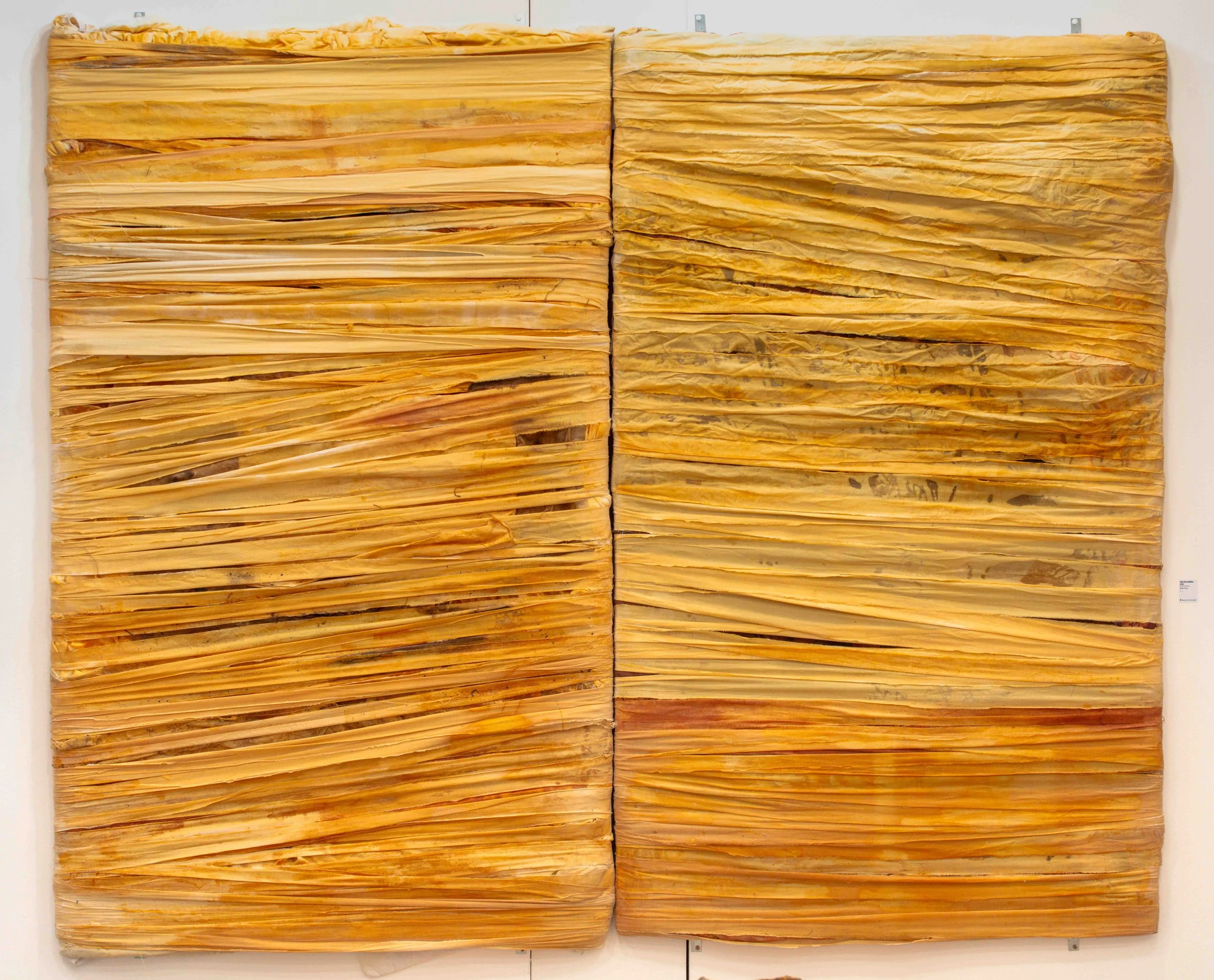
Component part of The Yellowing
November 2025